
The Five Pillars of Performance
Jun 29, 2026
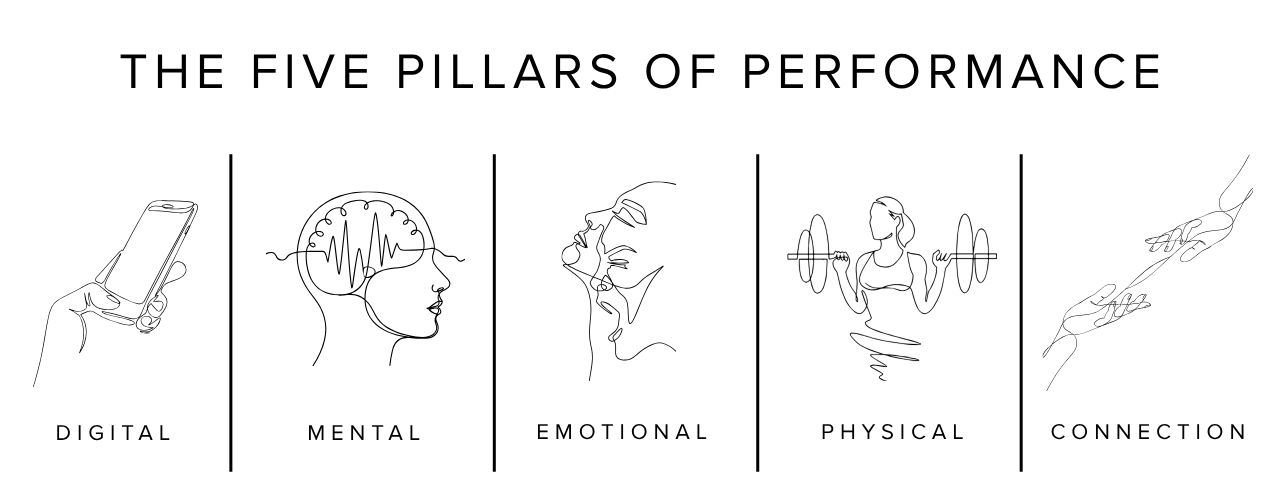
A framework for workplaces to improve staff performance, focus, resilience and wellbeing. It consists of five domains: Digital, Mental, Emotional, Physical and Social Connection.
For well over a decade of my corporate career, I had the performance equation backwards. I believed performance was something that came from pushing hard. More hours, more effort surely meant more results. I mean, watching the most successful business icons live and preach this lifestyle surely meant it was the right thing to do! Staying back late at night was a badge of honour. Leaving early, a career killer. I still recall a colleague getting a round of applause from everyone in the office when he left his desk at 5pm on the dot. To go pick up his daughter no less. Honestly, what were we thinking with that ridiculous behaviour back then?
To make matters worse, if anyone should know the importance of recovery and a work-smarter- not-harder mindset, it was me. I had spent the best part of 20 years of my life trying to be an elite sports person. Work hard and discipline of course. But just as important, recovery and practicing things perfectly. We had a saying; “Practice does not make perfect. Perfect practice makes perfect”.
So why five seconds into my corporate career (and 10 years later), was I using that work-hard and disciplined mentality to my advantage. And yet, I had completely forgotten the recovery and perfect practice mentality. What was wrong with me?!!
Fast forward, and it turns out Oscar Wilde was right, “wisdom comes with winters”. After 15 years in the corporate world, more basketball courts than I care to remember, and a postgraduate degree in mental health and neuroscience, it turns out there is a smarter, more sustainable, and far more enjoyable way to approach our everyday lives. We can perform better, by simply approaching work and life a little differently. If you don’t believe me, you only have to take a look at how the modern CEO and some of the biggest names in business like Jeff Bezos and Bill Gates have altered their approaches to high performance. Extreme focus on the things that are most important rather than spreading yourself thin. And prioritising recovery.
The Five Pillars of Performance Framework
We have identified five domains to create a wellbeing-first framework for sustainable performance based on the neuroscience of good mental health. This framework is designed to not only improve your productivity, but to improve your resilience, stress tolerance, mood and focus. Most importantly, it will make you feel good by taking care of your health and wellbeing. Bringing more joy, happiness and contentment into your life.
Pillar One: Digital
Protecting your attention from distraction.
The modern workplace and our modern lives (especially technology) have been engineered to fracture and fragment our focus. Tik tok brain, popcorn brain, the shallows, and many more terms have been created to illustrate how we have become constantly distracted. Kong et al. (2023) conducted a meta-analysis of 43 studies and found heavy media multitaskers had lower cognitive control, reduced inhibitory control and a poorer working memory. The very things we need for focus and deep work.
Jump on the Apple or Google App store and you will find no shortage of productivity apps that guarantee they will fix your focus and productivity issues. I have tried more than I can count, and whilst some are no doubt helpful, the greatest tool available to us is to fix our environment. It’s not sexy, it’s not fancy.
Instead, try:
Turn off notifications, stop push messages, using flight and focus mode, implement strategic breaks and wearing head sets. Master your digital environment and you are well on your way to more focus and more importantly, less stress.
Pillar Two: Mental
Building a mindset that thrives in change.
The second pillar is foundational in your ability to respond to challenges and uncertainty. Make no mistake, this is essential in today's AI driven world. The saying “change or be changed” has never been more true. Our mindset matters, as it is an essential lever to improvements in achievement, lower psychological distress and is critical for those that are suffering with mental ill health or considerable stress (Burnette et al., 2023).
Try this:
Building a stress-is-enhancing mindset is such a valuable and teachable skill, and one of the most effective strategies we have available is a simple cognitive reappraisal technique called ‘reframing’. When we reframe challenges into opportunities or potential, we are training our brain to have a stress-is-enhancing mindset. We can train our brain to thrive in pressure environments and view the challenges as eustress, helping us grow and move forward.
Pillar Three: Emotional
Routines for stress and emotional regulation.
When our third pillar falls down, the very structure that allows us to focus and thrive during uncertainty fails. Everyone faces stress. One might argue that if you don’t face any stress, you are probably not giving life a red hot crack. However, we all need tools and techniques to help us cope when stress gets too much, or we are faced with difficult and emotional situations. Further, it is important that we address chronic stress or allostatic load (where the cumulative load exceeds our ability to manage it) causing a degradation of physical and mental health.
Try this:
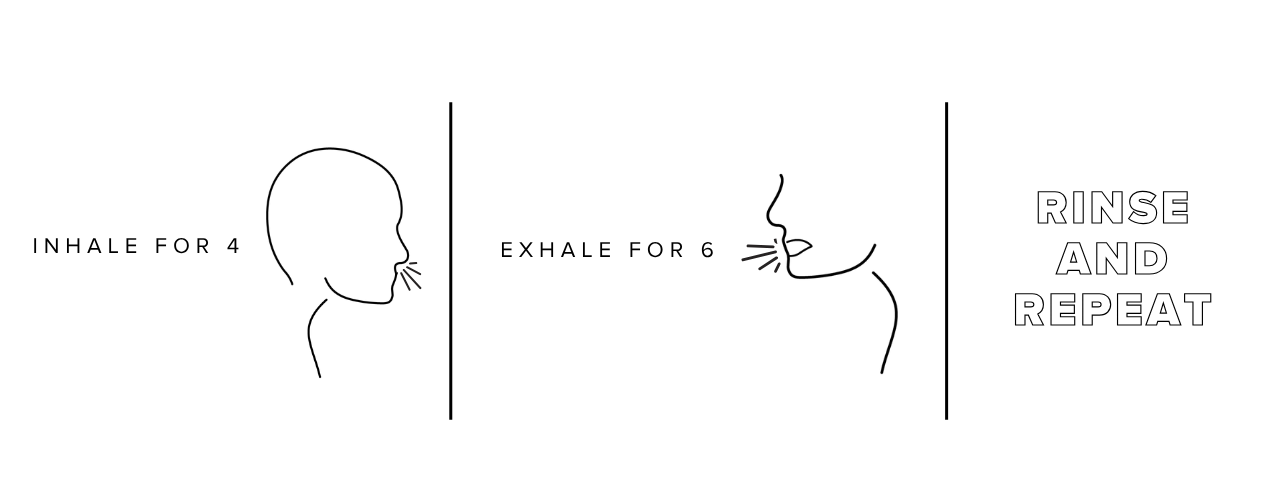
A simple, effective and zero cost tool that is available to everyone to transition from acute stress is deep breathing. We spend so much of our time in a sympathetic state (flight or fight mode), that we need to be able to downregulate and move into a parasympathetic state (rest and digest). We are not looking to avoid either one of these states, rather, have the ability to efficiently move between the two. The most effective way to do that is through deep breathing. Simply inhale for 4 and out for 6. Rinse and repeat. Simple, effective and fast and you don't need any fancy gadget or app. Just you and your breath.
Pillar Four: Physical
Managing your energy, not just your time.
A depleted body leads to a depleted brain. And for many of us, that is exactly how we show up to work, each and every day. Tired, fatigued and lacking motivation. When we are fatigued our brain starts searching for ways to restore dopamine. The fastest method being via ‘cheap dopamine’. Think quick hits of junk food, scrolling or alcohol to restore the dopamine balance. However, rather than replenish, it does the opposite, it depletes further. A study by Dora et al. (2021) found fatigue caused participants to pick up the phone and mindlessly scroll 36% more than those who felt refreshed. Being tired doesn’t just reduce your decision making, it destroys your focus and resilience.
Try this:
There are three components that are essential to ensure you are feeling and performing at your best best being; exercise, sleep and nutrition. These are the very foundation of your energy. First is exercise, which may be the most effective way to overcome your energy deficit. A systematic review by Chang et al. (2025) found that even a single bout of exercise improved cognitive performance, whilst sustained physical activity improves processing speed, memory, executive function and helps raise Brain Derived Neurotrophic Factor (a protein that acts like fertiliser for our brain).
Second, is sleep. In my opinion sleep is the most undervalued and underutilised performance tool we have. Quite simply, poor sleep will lead to poor performance. The best way to improve your sleep is to simply prioritise it. Set a regular bed time (and wake time), get off the screens an hour before bed, get your room very cool, dark and quiet and make sleep your number one priority. If you continue to struggle with sleep check out the Woolcock Institute for their amazing resources and team that can help with serious sleep issues.
Pillar Five: Social Connection
The foundation of our mental health and resilience.
We have moved away from many of the societal structures that promoted community and connection. Somehow connection has become a nice-to-have rather than an essential for health, vitality and longevity. But the figures show a very different picture. We are in a loneliness epidemic and according to the State of The Nation Report on Social Connection in Australia, loneliness leads to much poorer outcomes across productivity, mental health and general wellbeing.
Try this:
Nitschke et al., (2021) found that during periods of high stress and uncertainty, those that had high levels of social connection, were the most resilient. Social connection acts as a resilience buffer. However to connect, it takes time and effort. That means planning, prioritising and being ok that sometimes you just have to put yourself out there. I know personally, one of the best things I have achieved over the last few years is prioritising time with mates. Making the effort and just saying yes, when sometimes it would just be easier to say no. You can read more about the importance of connection here.
How to use the framework
The pillars certainly don’t work in isolation. They work as an integrated whole. Pillars and habits will compound over time. You don't need to be perfect, you just need to be consistent. Like interest in a bank, all the habits add up, providing you with a wellbeing structure that leaves you feeling great, and ready to perform.
One of the easiest places to start is to simply run an audit. Give yourself a rating across each of the pillars. Then check if you have a few go to tools that you can employ within each (you can find some here). Then little by little, target improving each pillar. Adding to your toolkit, improving your daily habits, to create a base.
If you think you could improve your performance, your wellbeing or your happiness, there is no better time than right now. You don't need any fancy apps or expensive equipment. We simply need to take stock of our little daily habits. Addressing one pillar at a time. Learn the lessons that took me way too long to realise. Working on the right thing, at the right time, with the right recovery, can improve your performance in all aspects of your life.
Learn more about Jay Pottenger’s Five Pillars of Performance, Workplace Wellbeing keynote here.
References
Burnette, J. L., Billingsley, J., Banks, G. C., Knouse, L. E., Hoyt, C. L., Pollack, J. M., & Simon, S. (2023). A systematic review and meta-analysis of growth mindset interventions: For whom, how, and why might such interventions work? Psychological Bulletin, 149(3–4), 174–205. https://doi.org/10.1037/bul0000368
Chang, Y.-K., Ren, F.-F., Li, R.-H., Ai, J.-Y., Kao, S.-C., & Etnier, J. L. (2025). The effects of acute exercise on cognitive function: A meta-review of 30 systematic reviews with meta-analyses. Psychological Bulletin. Advance online publication.
Dora, J., van Hooff, M. L. M., Geurts, S. A. E., Kompier, M. A. J., & Bijleveld, E. (2021). Fatigue, boredom and objectively measured smartphone use at work. Royal Society Open Science, 8(7), Article 201915. https://doi.org/10.1098/rsos.201915
Kong, F., Meng, S., Deng, H., Wang, M., & Sun, X. (2023). Cognitive control in adolescents and young adults with media multitasking experience: A three-level meta-analysis. Educational Psychology Review, 35(1), Article 22. https://doi.org/10.1007/s10648-023-09746-0
Lim, M. H., Smith, B. J., Owen, K. B., Engel, L., Qualter, P., & Surkalim, D. L. (2023). State of the nation report: Social connection in Australia 2023. Ending Loneliness Together. https://endingloneliness.com.au/resource/state-of-the-nation-report-social-connection-in-australia-2023/
Nitschke, J. P., Forbes, P. A. G., Ali, N., Cutler, J., Apps, M. A. J., Lockwood, P. L., & Lamm, C. (2021). Resilience during uncertainty? Greater social connectedness during COVID‑19 lockdown is associated with reduced distress and fatigue. British Journal of Health Psychology, 26(2), 553–569. https://doi.org/10.1111/bjhp.12485