
Why Deep Work is Dying? It Might Be The Recalibration Effect
Sep 01, 2026
The cost-benefit calculation that’s holding your brain back.
Every week we hear the same concern: “ I have lost my ability to concentrate, I can barely even watch a full TV show, let alone a movie anymore”. It's like a low grade form of brain-shame. You feel like you have lost the ability to get ‘good’ work done because you can’t focus long enough to produce the effort it requires. Is deep work is dying?
Recently, neuroscience research has started to explore why. The theory suggests that our digital habits are not destroying our capability to focus. Instead, our brains are just choosing to engage in the easy option. That distraction or that low effort choice, is far more appealing than having to really concentrate and put in the mental effort that concentration requires. Simply, distraction is easy, concentrated effort is hard. We call this the Recalibration Effect
The Problem. We can focus, we are just less willing to try.
It might be surprising, but if we put you in a lab, and wired you up with fancy equipment to test your focus and your memory, odds are you would perform not dissimilar to previous generations. Our raw cognitive capacity appears not to have collapsed.
However, if we place you at a desk or in your home, with a 50 page report, the ability to concentrate falls apart. 20 years ago this gap between lab performance and real world performance was minimal. But fast forward to today, and the gap between the lab and the real world is probably immense. But that shouldn’t come as a surprise. Our modern environment is filled with an endless supply of distractions, notifications and entertainment choices. In every direction we look, instant gratification.
The Recalibration Effect
A paper by Wiradhany et al., 2026 describes effort recalibration as - the gradual and largely invisible process by which your environment trains your brain to see that difficult and meaningful work as hard and simply not worth the mental effort.
In fairness, the cards are stacked against us. Digital environments are built on the knowledge that cheap dopamine is an easy and effective way to keep people engaged in short term distractions. Notifications, infinite scroll and clever algorithmic feeds keeps the novelty high and the effort almost zero. The consequences for long term productivity are significant. Overcoming this requires sacrificing the now for the later. Something our brains have not evolved to do since we are wired to choose the immediate reward in order to survive. In modern times, our demands look very different and delaying gratification can be a very important skill set. However, as the recalibration effect starts to take hold: a slow erosion of willingness to engage in the hard, makes this short term sacrifice even more challenging.
A popular statistic doing the media rounds after a neuroscientist made the claim, is that ‘it takes 23 minutes for people to refocus after an interruption’. We don’t know if this is accurate, but there is little doubt that distractions are everywhere and it takes time to refocus. A small workplace study by Talypova et al. (2025) found during their research people deviated from their main task every 3.5 minutes. Worse still, during sustained focus sessions, they could only average six minutes of concentrated effort. Given it takes a lot of people longer than six minutes to get into a flow state, that number seems highly problematic for getting meaningful work done.
For organisations, the stakes are higher. Deep work, strategic thinking, complex problem solving are the very tasks that are being avoided, because they require mental energy. The recalibration effect is moving people from value delivering work, to shallow and simple tasks.
The Solution. Recalibration can work both ways.
If our brain is constantly in a cost-benefit calculation, willpower alone isn’t the solution. It’s very hard to out-discipline a powerful reward system. We have to re-recalibrate it with deliberate intention. Creating a process that can be repeated and rewarded in the same way the system got misdirected.
A four lever framework
The 4Rs can help rewire our ability to stay focused and rebuild our capacity for deep work. The system is not broken, we just need to create a process to help us thrive.
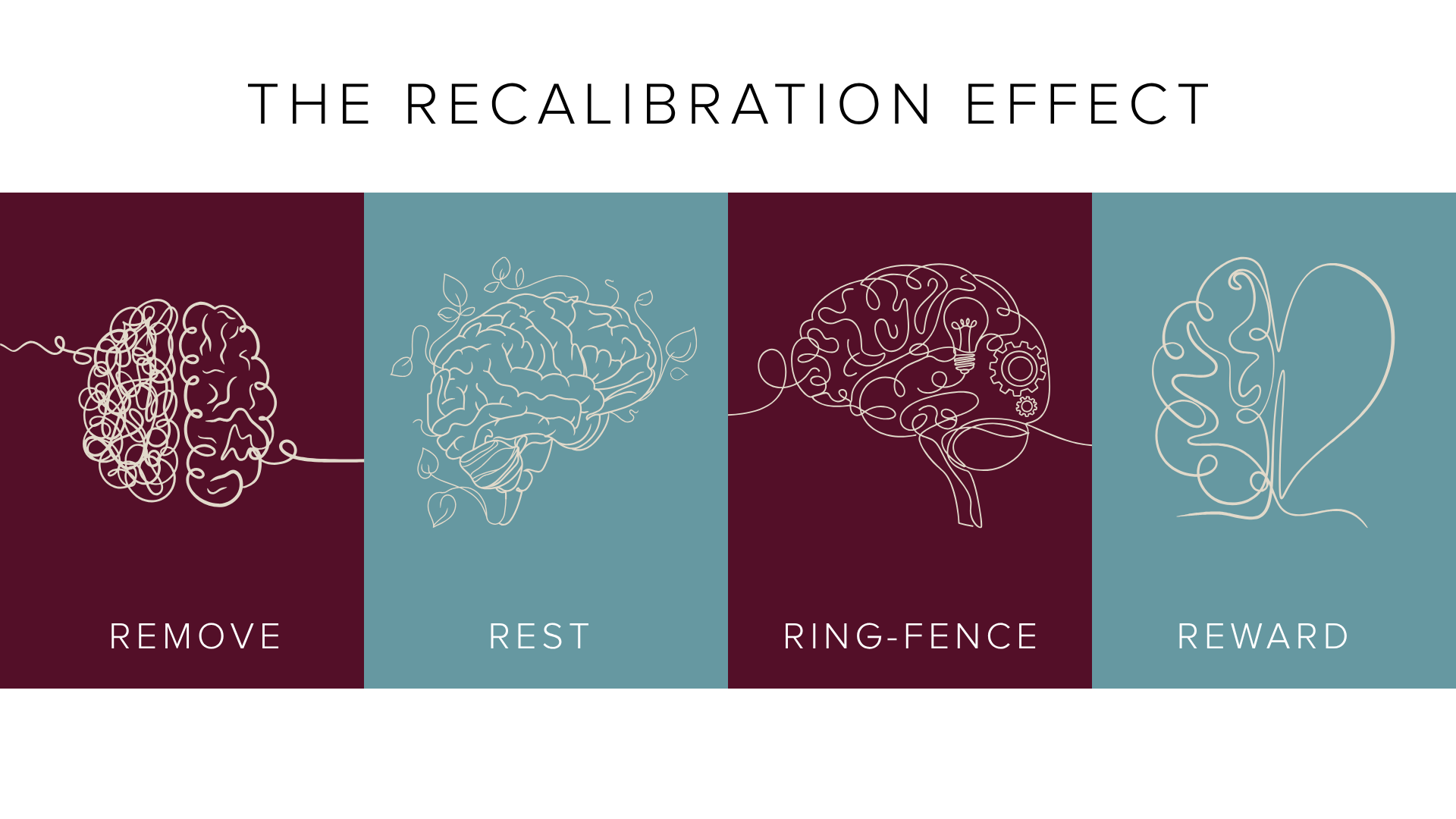
Lever One: Remove
Friction can work for you and it often works against you with constant disruptions. We need to design our environment so the low effort rewards are less likely to interrupt your high effort work.
Practical Application: Turn off all notifications, push notifications and message/email banners. All of them. Delete the apps that consume your time and your energy. If you must keep them, move them from your home screen. Use Focus Mode to ensure that when you sit down for deep work, you are not interrupted by annoying phone calls.
Lever Two: Rest
Your brain operates best when it’s well rested. If your body is tired, your brain is less resilient and more likely to choose the easy option. That means cheap dopamine becomes more appealing than heavy work. A study found that if participants were fatigued, they were 36% more likely to pick up their phone.
Practical Application: Sleep should be at the top of your to do list, not the bottom. Set a nighttime alarm so that you have time to wind down and get off the screens one hour before bed. It will protect not only your sleep regularity but your rapid eye movement sleep too.
Lever Three: Ring-fence
Use time-blocking to pace your calendar. For many people, the last ten years has been spent training our brains for fragmentation and distraction. Quick and shallow wins. You cannot expect just to flick a switch and move into four hour blocks of deep work. Your brain will explode (not literally). We must build up our focus muscle, bit by bit.
Practical Application: Try the Pomodoro Technique. Set up lever 1 and lever 2 and then block out 25 minutes of uninterrupted time in your calendar to do deep work. No distractions, no excuses, just getting into the flow. Set a timer for twenty five minutes and watch how much you can achieve. If the timer goes off and you're in the flow, keep on going.
Lever Four: Reward
Your brain loves rewards. It’s the very reason that deep work is so challenging. So we need to figure out how to bring a long term payoff into the short term. According to research at Harvard Business School, the key motivator in rewarding work is simply progress. Rewarding progress helps us move forward and embed these good habits that are more challenging, so the payoff is greater in the future.
Practical Application: Keep a visible tally of the wins. 25 min block of deep work, name the project, tick it off. 30 min work, undistracted. Name it, tick it off. Watch the tally grow and your motivation build.
The 4R framework is not a quick fix. Recalibrating a system that has been laying down strong distraction pathways for years, needs time to rework. But applying the 4 levers consistently can provide a framework to ensure your environment and motivation becomes aligned with your long term goals.
Deep work is not dead, the recalibration effect may just be making your brain less likely to want to put in the effort to do it.
Train your team overcome the recalibration effect with Jay Pottenger's Focus & Productivity workshops: https://www.eqminds.com/Jay-pottenger-keynote-speaker
FAQs
What is deep work?
Deep work is the ability to focus, without distraction, on a task that demands real mental effort. It’s a level of sustained focus that produces your best thinking and your best output.
What is the Recalibration Effect?
The Recalibration Effect is the gradual, largely invisible process by which your environment trains your brain to see difficult, meaningful work as not worth the mental effort. Over time, constant access to easy dopamine (notifications, scrolling, quick entertainment) makes hard, focused work feel harder than it actually is.
Why can't I focus anymore?
A theory is that your brain has been trained by your environment to prefer low-effort, high-reward distractions over sustained effort, making focus feel much harder than it used to.
What is the 4R framework?
The 4R framework is a four-step approach to rebuilding your capacity for deep work. Remove distractions from your environment, Rest so your brain isn't running on empty, Ring-fence time for focused work using techniques like time-blocking, and Reward progress to reinforce the habit.
References
Amabile, T. M., & Kramer, S. J. (2011). The progress principle: Using small wins to ignite joy, engagement, and creativity at work. Harvard Business Review Press.
Dora, J., van Hooff, M., Geurts, S., Kompier, M., & Bijleveld, E. (2021). Fatigue, boredom and objectively measured smartphone use at work. Royal Society Open Science, 8(7), 201915. https://doi.org/10.1098/rsos.201915
Talypova, D., Visuri, A., Shahu, A., Wang, A. Y., & Wintersberger, P. (2025). Are six minutes of focus enough? An exploratory study of multitasking patterns in workplace environments. In Proceedings of the 4th Annual Symposium on Human-Computer Interaction for Work (CHIWORK '25) (pp. 1–15). ACM. https://doi.org/10.1145/3729176.3729198
Wiradhany, W., Parry, D. A., & Aru, J. (2026). An effort recalibration framework for digital media use and cognition. Nature Human Behaviour. https://doi.org/10.1038/s41562-026-02500-w